

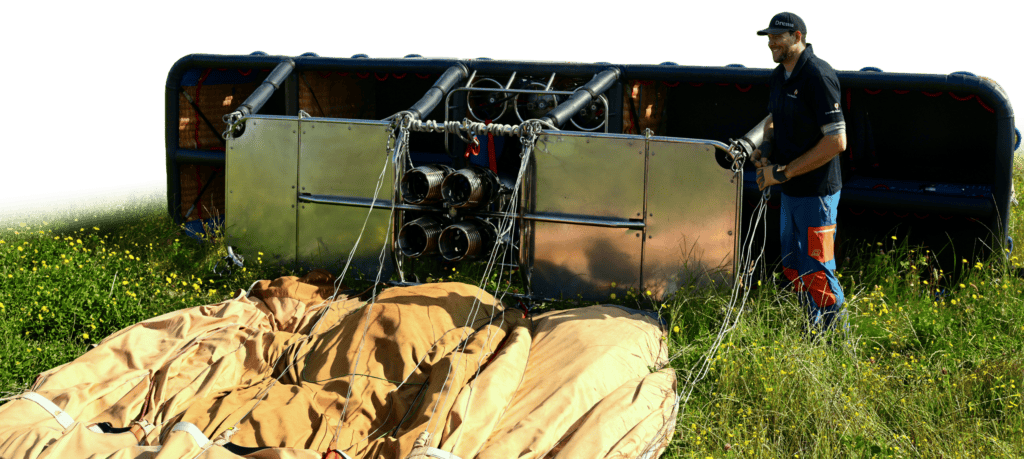
The Envelope
The envelope is the balloon’s most visible component. Modern envelopes are made from rip-stop nylon or polyester, sewn into vertical panels called gores. A typical sport balloon holds around 2,800 cubic metres of air and stands roughly 20 metres tall when inflated. The fabric is coated to reduce porosity and resist UV degradation. At the very top sits the parachute valve, a circular panel the pilot can open to release hot air for descent.
The Burner
The burner is the engine of a hot air balloon, though calling it an engine feels wrong given how simple it is. Liquid propane flows from tanks mounted inside the basket, through a coil where it vaporises, then ignites in a controlled blast that can reach temperatures of over 1,000\u00b0C. A single burn lasting a few seconds can maintain altitude; a longer burn sends the balloon climbing.
The Basket
Wicker is not a quaint choice. It is the best material for balloon baskets because it is lightweight, incredibly strong, and flexes on impact rather than cracking. A wicker basket absorbs the bump of landing in a way that aluminium or fibreglass cannot. Most baskets carry 4 to 6 passengers plus the pilot, with separate compartments for propane tanks.
Types of Balloon
Beyond the classic sport balloon, there are special shapes (corporate or novelty balloons shaped like animals, bottles, or buildings), tethered balloons (anchored to the ground for observation or advertising), and gas balloons (filled with helium or hydrogen for long-distance endurance flights). The balloons we fly at DreamBalloon are Cameron and Kubicek sport balloons, chosen for their safety record and flying characteristics.